

It’s a bird! It’s a plane! It’s a garage?…NO! It’s a barn!

This is the little structure that could. It started out life as a garage, a two-car garage to be specific. It lived its quiet, two-car garage life for 15 years. Then we bought the house that it was cohabitating with, and then…everything changed.

It started slowly…First, Bill didn’t want to sacrifice the entire garage, and also didn’t want to sacrifice more of the yard for a barn, so a compromise is reached over time, after much perusing of chicken coop plans and barn layouts and reference books and internet research.

Next, he got his ideas down on paper and reworked it all until he was satisfied with the logistics of it. Then he found someone that was willing and able to work with him to make the plan become a reality. And finally, the biggest miracle of it all, is the person actually showed up and did the work he had agreed to do when he agreed to do it!

Mindboggling in the construction world, isn’t it?

This slideshow requires JavaScript.

The cupola was added after much back-and-forthing about whether the weathervane should be a chicken (which we have) or a llama (which we wish we had but don’t have now). We even took a poll right here on kwrites to get your input. We settled on the llama, because llamas are talented guarders of chickens.

Most recently, the barn door was added to the front of the garage and the transformation is (I think!) complete. Well, for now.

Where I saw a garage,  Bill saw a barn…and now it is a barn.

Cool, huh? 🙂

The Donut Hole

Donut Hole

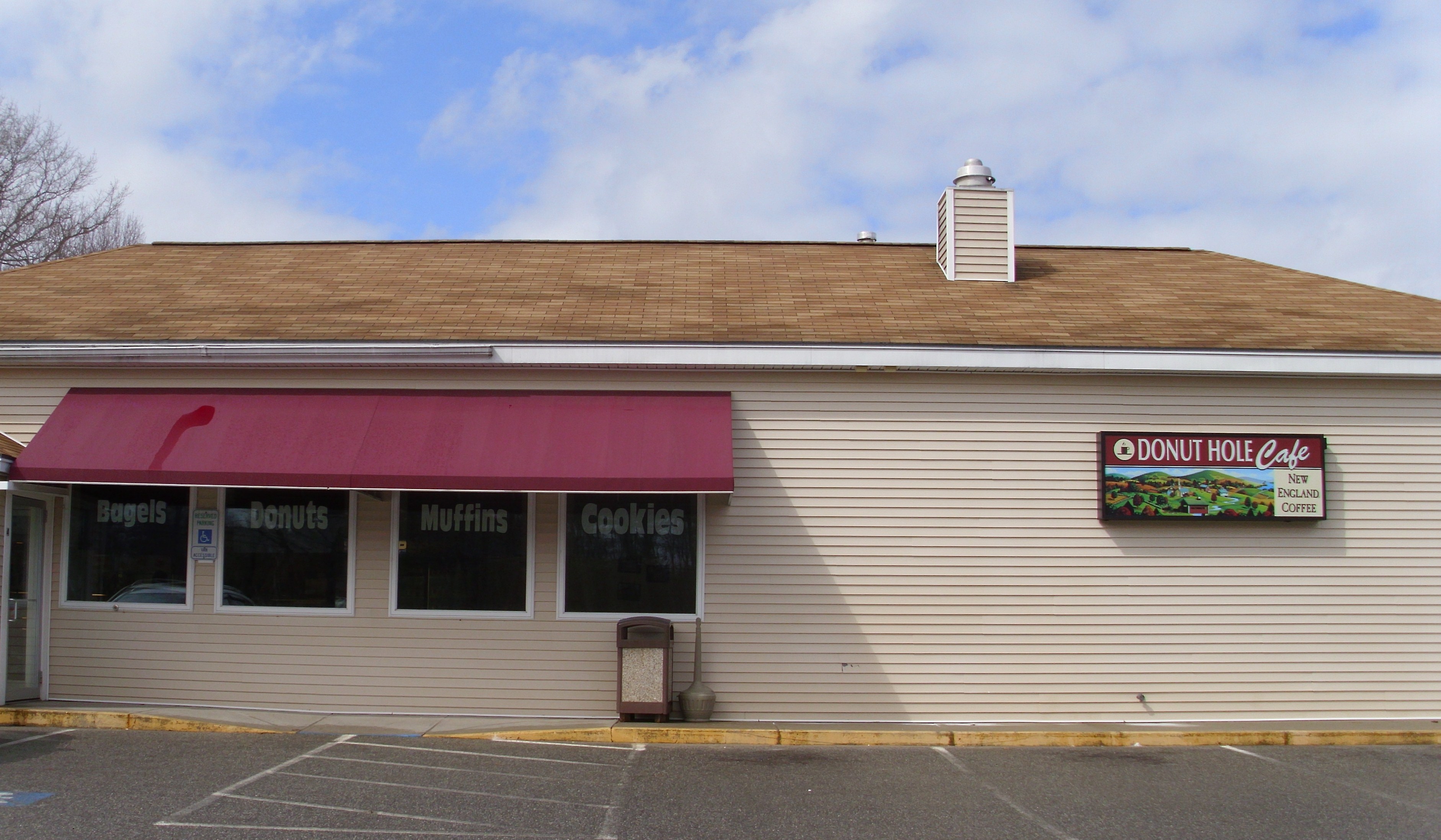
 The Donut Hole ((207) 929-5060) is located in Buxton, ME and is a cute little place with a variety of offerings…all good. I found it one day when my daughter and I were on an errand for my husband: a run to pick up baby chicks at Andy’s Agway, a truly taxing  job which required small baked goods be applied liberally post pick up.

My tween daughter and my husband had been to The Donut Hole before without me when they came to Agway on a similar chicken-raising related errand and had enjoyed their purchases very much.

Izzy got ice cream at her last visit, and even though it was only 10:30 am she wanted to order that again, so I said okay. Hey, ice cream has calcium, right?

I, of course, had to order a cupcake (all right, TWO cupcakes~they were too darn pretty to choose just one!) to try them out, as well as an eclair. Izzy and I took them home, cut them in half, and spread the eating of them out over a couple of days. Everything we bought was delicious…including the ice cream (of course she shared a little of her ice cream with me!). They make eclairs two different ways, so be sure to ask the staff what the difference is. 
I bet you’re thinking of excuses to run to Agway right about now, huh?  🙂

This slideshow requires JavaScript.

A bird in the hand

The Big Chickens (including Pidge)

One of my roles is Farmer (well, Wife of Farmer, to be more accurate). As such, I have a morning (and evening) routine when the primary farmer is away.

  1. Get coffee. (Get coffee is always Rule Number One, no matter what). 🙂
  2. Feed the Teenager Chickens in the transitional coop; refill their water as needed.
  3. Feed the Big Chickens; they are now on a very efficient self watering system that my husband designed and set up (this totally rocks!).
  4. Gather up any eggs.
  5. Evening: repeat.

I do most chores that are part of chicken rearing without any problem, but have heretofore drawn the line with a couple of things: I don’t check the vents for egg bound chickens and I don’t remove the dead bodies from the general population. Those jobs belong to Farmer #1 (or my son does it by default when my husband is not available). In short, Man’s Work.

Well, last evening as I entered the coop with the feed scoop held aloft, the Big Chickens ran toward me in one giant chicken wave as always…except one. There was Pidge, laying on her side, legs out behind her, lifeless. Poor Pidge (short for Pigeon, so named because of her coloring and size) had not been herself for a week or so, but in the two days prior seemed to be recovering well and we thought she was going to make it. Just that morning she had flown up to meet me when I brought the morning feed out to them. I took a closer look at her.

Dead dead dead.

The cartoon-like caricature of death flashed into my mind, complete with “X”‘s where the eyes should be and I superimposed the image on Pidge. (The eyes really did look blank like that!).

As an RN, I automatically reviewed the procedure for the pronouncement of death and had a moment of black humor as I envisioned checking the apical pulse and blood pressure on the little hen. I reviewed my options: Husband and son both at work and neither would be home for hours. I couldn’t in good conscience leave the corpse in the coop with the general population for that long.

I was going to have to Man Up.

I recalled a female friend who raised chickens telling me that the worst part (of disposing of the dead chickens) for her was handling them. Her work-around method for avoiding this was to put on a pair of work gloves then get a shovel to pick up the dead bird and remove it from the coop.

I got my (husband’s) gloves. I got my shovel. I got up my nerve and I entered the coop. I focused my gaze just to the right of Pidge, picked her up with the shovel, and took her to her final resting place.

The lesson here? Don’t name your chickens.

Footnote: I just named a chicken last week: Coconut. I am ever hopeful I guess.

Coconut

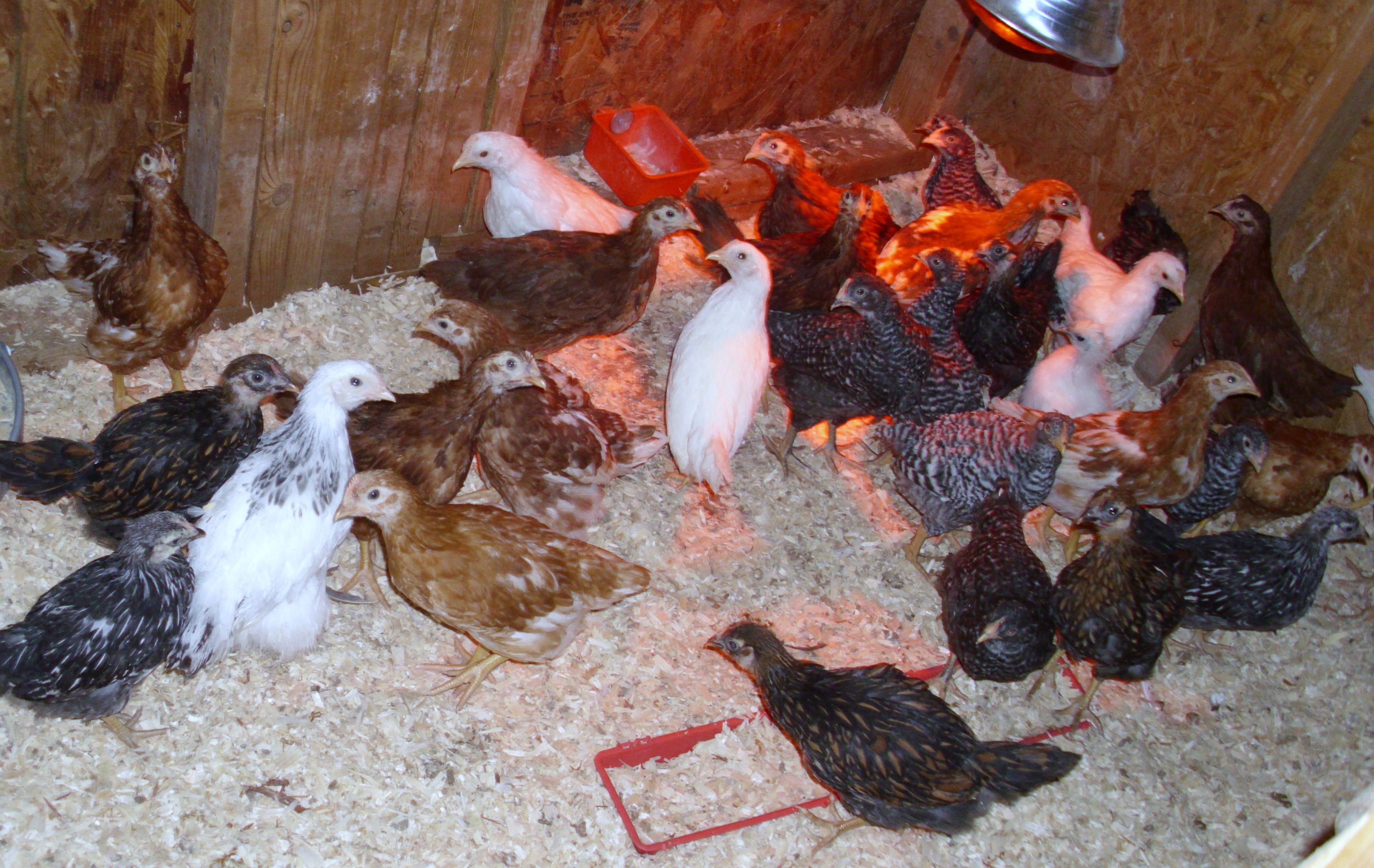
Spring chicks update, week 5: Teens in transition

The peeps have graduated!!!  They are “teenagers” now…each week in a chicken’s life roughly corresponding to 3 to 4 years in an adult’s life (in my non-expert opinion).

They are big enough to move to the transitional coop where they can see the big chickens and the big chickens can see them. This gives both populations a chance to get used to being together while allowing the teenagers to get a little bigger, enabling them to hold their own when they are assimilated into the larger population in the main coop.

We usually start this transitioning when the chicks get to be about 5-6 weeks old, but how big they’ve gotten, how strong they seem, how (awful) the weather is…all these things are considered when we are timing the move.

They are currently eating up a storm. Bright and active, they are still somewhat skittish as they adjust to their new digs. My son commented that he thought that his batch of chicks was friendlier overall than prior ones; they tolerated our picking them up without much fuss. This comes in handy when friends come to visit and want to hold a chick.

We have about 19 teenagers at the moment (well, 20 counting my son, who will not be one for much longer either, come to think of it), and as they get older we are learning that the breeds may turn out not to be what we ordered. Determining the sex of a chick is not an exact science, and some vendors are better at it than others. The White Leghorns  (might be White Rocks) and the Light Orpingtons (might be Buff Orpingtons) are in question at the moment, but as is true with most things, time will tell.

They should be off the heat lamp by next week. For now, they are adjusting well to their Brave New World.

🙂

This slideshow requires JavaScript.

Peeps update: week 2

So, week two with the peeps and life is good. Losses have been  minimal (despite the frigid temperatures after the balmy ones and a malfunctioning heat lamp). In about 5 months, our egg production should be through the roof. We’re gathering about 30 (or more!) eggs per day now and the peeps are eating and drinking twice as much.

We got about a dozen chicks from Tractor Supply Company, half Comets and half Barred Rocks. A few days later we got about 2 dozen more from Longhorn. This second batch was a mix of White Leghorns, Gold and Silver Lace Wyandottes, Rhode Island Reds, and a couple of Buff Brahmas (with the feathered feet!). The majority of these breeds are brown egg layers. We’ll get the white and the blue/green egg layers in June~none were available in February.

In June we will also have a first. Our first Italian chickens! My husband’s nod to my love of All Things Italian: Anconas. I can’t wait! I wonder if Ancona eggs will make better frittatas? 🙂

This slideshow requires JavaScript.

Expanding the flock~(revised)

…is proving to be no easy task this spring. My husband anxiously anticipated the arrival of the chick catalogues, nad contacted some new (to us) hatcheries for their catalogues, and planned to get some chicks from New Mexico in March and from Texas in June. At the end of February they wouldn’t accept the March order; they wanted to send them the next day, but we learned last year (the hard way) that February in Maine is too early to get the chicks. When he called back in March (two weeks later), there were no chicks to be had…until June. He made some more calls to other vendors and was given the same verdict.

Bummer.

This is the first time this has ever happened since we first started raising chicks in 2006. Next, my husband hit the road to see what the stores in our area were offering.

We were hopeful as we entered Tractor Supply Company in Sanford…but alas, the only “peeps” they had on Monday were the marshmallow kind, just to the right of the door as you enter the store, and the stuffed kind (the ones that actually “peep” when you press on their stomachs~too cute!). On the plus side, this gave me a nudge to get going with my Easter Basket planning. Note to self: go back to Tractor Supply alone (read: without husband who doesn’t get the whole “Easter Basket” concept) to shop for the baskets.

Longhorn? They’ll have them on Monday. Tractor Supply? Has some now, but not any that we want.

The idea of hatching our own is starting to look more appealing…

Anyway, the stage is set (warming lights on, tiny waterers at the ready) in our home-made brooder (which is a 4×4 wooden box). If and when the chicks arrive, we are ready!

Winter bounty

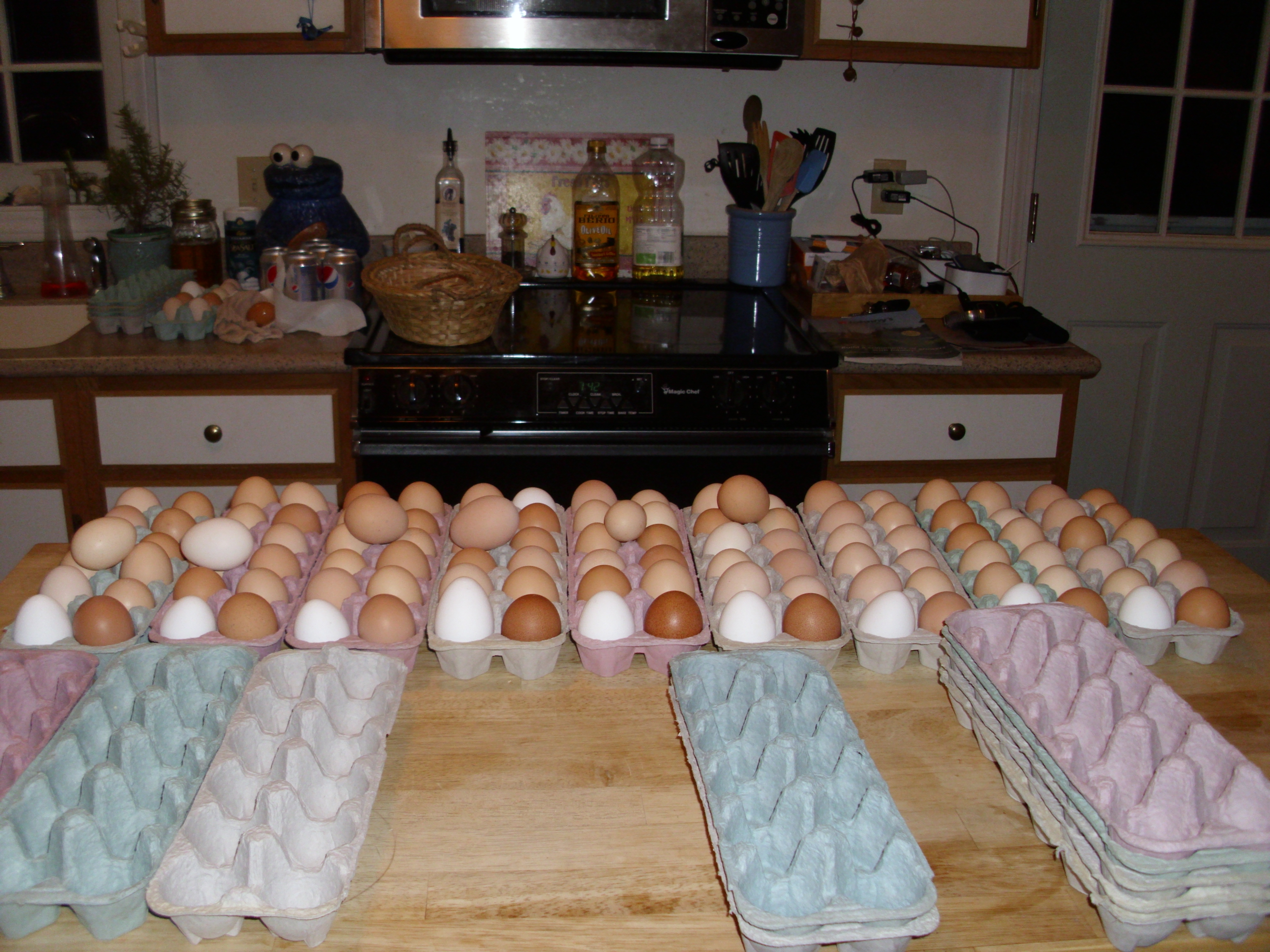
Lately we’ve been getting so many eggs because we’ve (well, full disclosure: it’s mostly been my husband) been working on the timing of new chicks. . . the September 1st chicks have now begun laying brown eggs. In the spring, we will refresh the white and green egg layers.

We used to only get new chicks in the spring; now we get new chicks in the fall as well.

Eggs, ready for bagging

The girls have been working overtime producing up to two dozen eggs per day, depending on variables, some known (like availability of water, food, and light, the presence of predators nearby),  and some we can only imagine (“She’s touching me! Make her stop touching me!”).

Some credit must be given to the boys, too.  We have a few roosters, one dominant, and a few lesser that know to stay out of his way. Right now, they have a good balance of boys to girls, so everyone is getting along. Harmony in the flock is most certainly conducive to good egg production.

Basically, chickens are happy campers. They eat, sleep, lay eggs, and peck the ground and each other. If they have thoughts, our consensus is that this it is one, shared, universal thought. Here it is:

“I’m a chicken! I’m a chicken! I’m a chicken!”

For all of the people who wonder why we bag the eggs: it’s for health reasons. It just seems more hygienic than reusing the egg cartons. Also, it keeps costs down.

:>)

This slideshow requires JavaScript.