
A bird in the hand

The Big Chickens (including Pidge)

One of my roles is Farmer (well, Wife of Farmer, to be more accurate). As such, I have a morning (and evening) routine when the primary farmer is away.

  1. Get coffee. (Get coffee is always Rule Number One, no matter what). 🙂
  2. Feed the Teenager Chickens in the transitional coop; refill their water as needed.
  3. Feed the Big Chickens; they are now on a very efficient self watering system that my husband designed and set up (this totally rocks!).
  4. Gather up any eggs.
  5. Evening: repeat.

I do most chores that are part of chicken rearing without any problem, but have heretofore drawn the line with a couple of things: I don’t check the vents for egg bound chickens and I don’t remove the dead bodies from the general population. Those jobs belong to Farmer #1 (or my son does it by default when my husband is not available). In short, Man’s Work.

Well, last evening as I entered the coop with the feed scoop held aloft, the Big Chickens ran toward me in one giant chicken wave as always…except one. There was Pidge, laying on her side, legs out behind her, lifeless. Poor Pidge (short for Pigeon, so named because of her coloring and size) had not been herself for a week or so, but in the two days prior seemed to be recovering well and we thought she was going to make it. Just that morning she had flown up to meet me when I brought the morning feed out to them. I took a closer look at her.

Dead dead dead.

The cartoon-like caricature of death flashed into my mind, complete with “X”‘s where the eyes should be and I superimposed the image on Pidge. (The eyes really did look blank like that!).

As an RN, I automatically reviewed the procedure for the pronouncement of death and had a moment of black humor as I envisioned checking the apical pulse and blood pressure on the little hen. I reviewed my options: Husband and son both at work and neither would be home for hours. I couldn’t in good conscience leave the corpse in the coop with the general population for that long.

I was going to have to Man Up.

I recalled a female friend who raised chickens telling me that the worst part (of disposing of the dead chickens) for her was handling them. Her work-around method for avoiding this was to put on a pair of work gloves then get a shovel to pick up the dead bird and remove it from the coop.

I got my (husband’s) gloves. I got my shovel. I got up my nerve and I entered the coop. I focused my gaze just to the right of Pidge, picked her up with the shovel, and took her to her final resting place.

The lesson here? Don’t name your chickens.

Footnote: I just named a chicken last week: Coconut. I am ever hopeful I guess.

Coconut

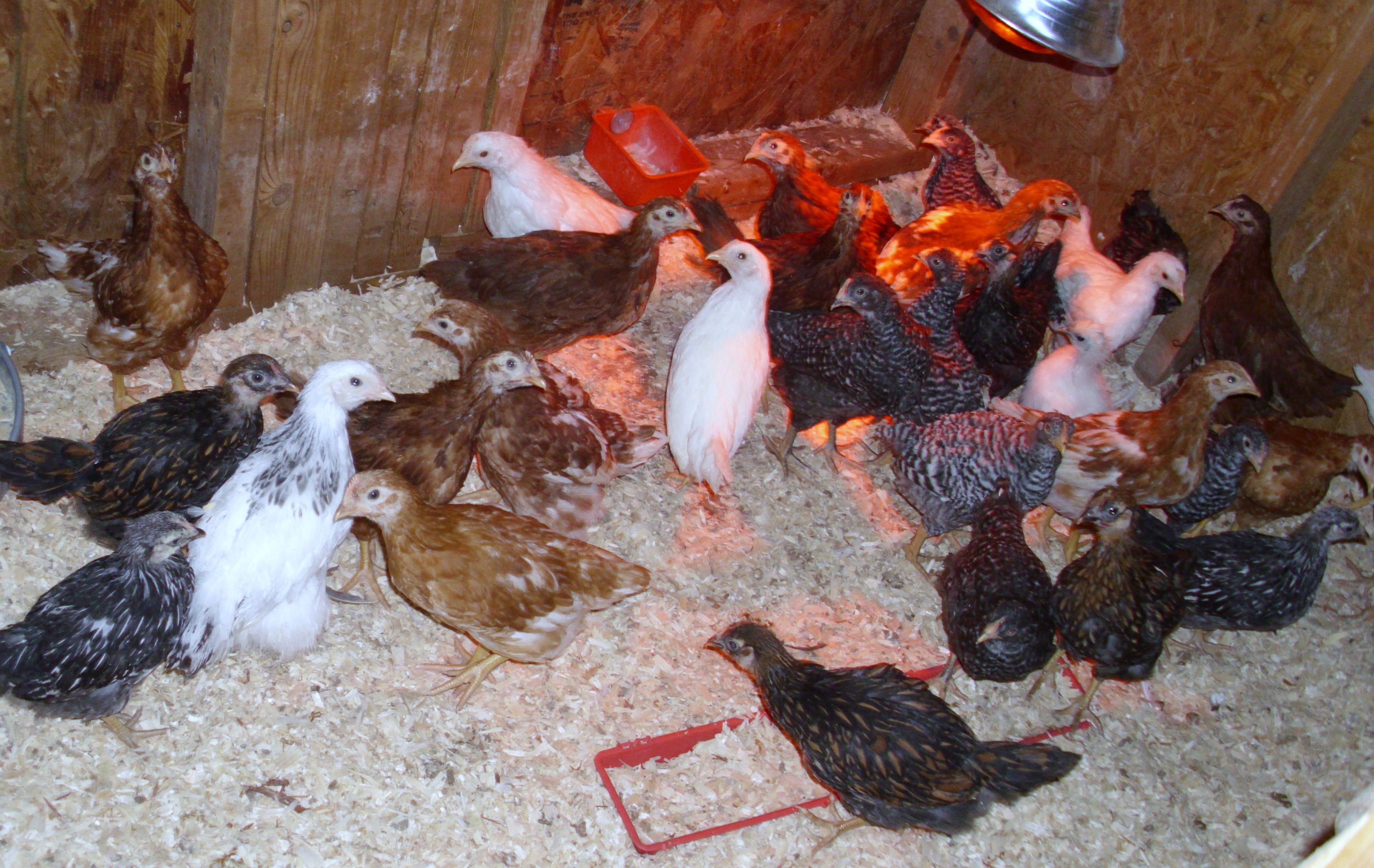
Spring chicks update, week 5: Teens in transition

The peeps have graduated!!!  They are “teenagers” now…each week in a chicken’s life roughly corresponding to 3 to 4 years in an adult’s life (in my non-expert opinion).

They are big enough to move to the transitional coop where they can see the big chickens and the big chickens can see them. This gives both populations a chance to get used to being together while allowing the teenagers to get a little bigger, enabling them to hold their own when they are assimilated into the larger population in the main coop.

We usually start this transitioning when the chicks get to be about 5-6 weeks old, but how big they’ve gotten, how strong they seem, how (awful) the weather is…all these things are considered when we are timing the move.

They are currently eating up a storm. Bright and active, they are still somewhat skittish as they adjust to their new digs. My son commented that he thought that his batch of chicks was friendlier overall than prior ones; they tolerated our picking them up without much fuss. This comes in handy when friends come to visit and want to hold a chick.

We have about 19 teenagers at the moment (well, 20 counting my son, who will not be one for much longer either, come to think of it), and as they get older we are learning that the breeds may turn out not to be what we ordered. Determining the sex of a chick is not an exact science, and some vendors are better at it than others. The White Leghorns  (might be White Rocks) and the Light Orpingtons (might be Buff Orpingtons) are in question at the moment, but as is true with most things, time will tell.

They should be off the heat lamp by next week. For now, they are adjusting well to their Brave New World.

🙂

This slideshow requires JavaScript.

Peeps update: week 2

So, week two with the peeps and life is good. Losses have been  minimal (despite the frigid temperatures after the balmy ones and a malfunctioning heat lamp). In about 5 months, our egg production should be through the roof. We’re gathering about 30 (or more!) eggs per day now and the peeps are eating and drinking twice as much.

We got about a dozen chicks from Tractor Supply Company, half Comets and half Barred Rocks. A few days later we got about 2 dozen more from Longhorn. This second batch was a mix of White Leghorns, Gold and Silver Lace Wyandottes, Rhode Island Reds, and a couple of Buff Brahmas (with the feathered feet!). The majority of these breeds are brown egg layers. We’ll get the white and the blue/green egg layers in June~none were available in February.

In June we will also have a first. Our first Italian chickens! My husband’s nod to my love of All Things Italian: Anconas. I can’t wait! I wonder if Ancona eggs will make better frittatas? 🙂

This slideshow requires JavaScript.

New Arrivals

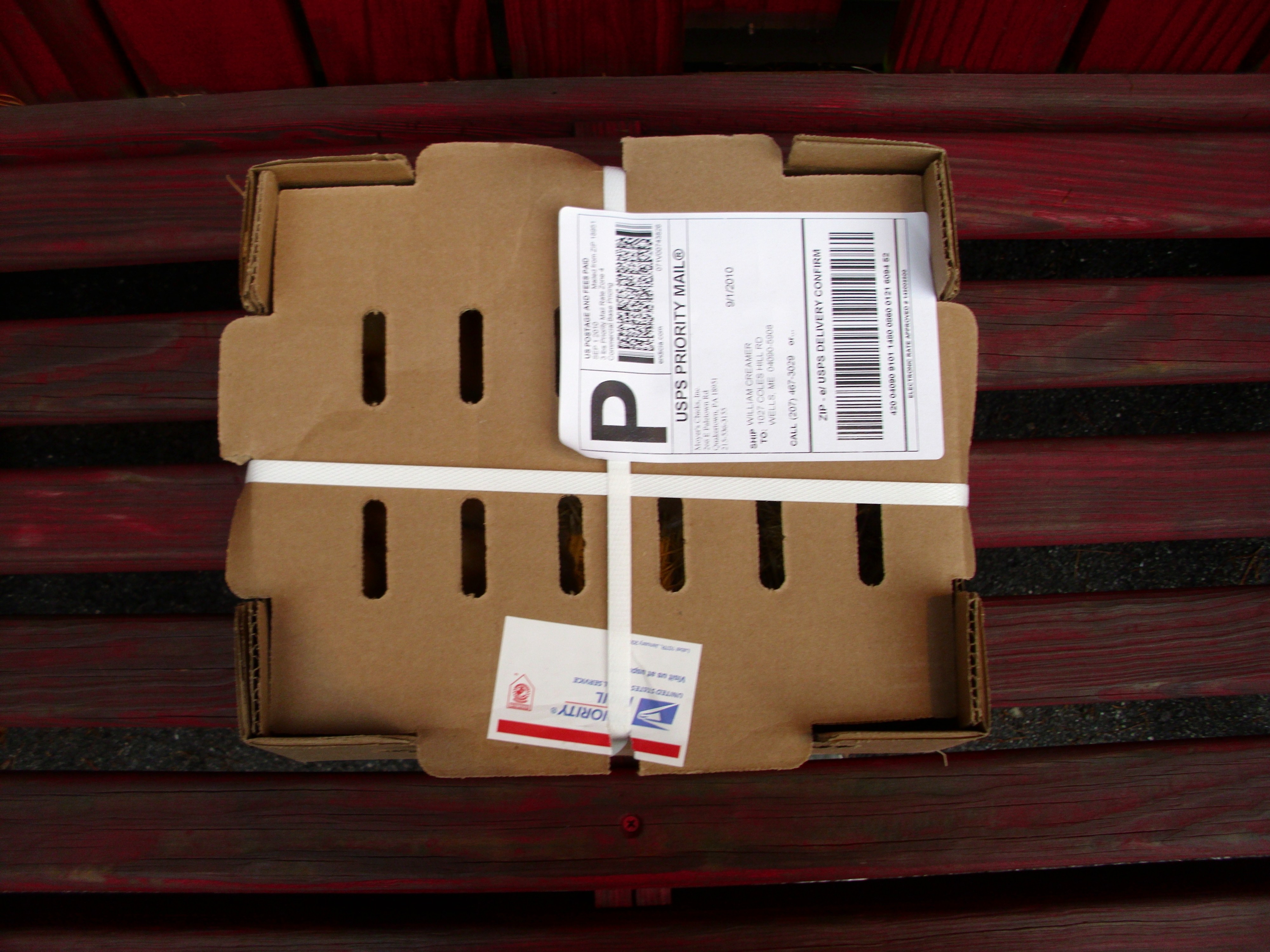
The new peeps were born last Wednesday and scheduled to arrive on Thursday, Friday the latest, through the mail. We did order from a new vendor, one we hadn’t ordered from in the past. We chose them this time because they allowed us

New arrivals

to buy 20 at a time instead of 25. They were cheap; like, half the price of the other vendors. It was also closer; they would ship from Pennsylvania, not Iowa or Texas. This had to be easier on peeps-in-transit, we reasoned.

So, as we’ve done at least a half a dozen times before, we placed our order, confident that they would arrive as scheduled. So confident, that when they did not come on Thursday, my husband went to the post office on Friday morning to get the package.

When they said they didn’t have a package for us, he listened carefully for the tell-tale “peep peep peep”, but heard nothing.

This was not good. Little peeps theoretically can live for up to 72 hours (key words here are “up to”), but they certainly also might not.

On Saturday, at 6:39am, the call came. The chicks had arrived! The news was promising: the package was “peeping”. I went to pick it up, dreading what we might find when we opened it. Both kids and I held our breath…

Well, the good news was this: all 21 chicks were living and peeping. All took a drink when coaxed. All found the food.

The bad news is this: with in 2 days, we had 6 dead bodies.  We’d never lost more than 1 0r 2 chicks right away like that. It was kind of awful. Every time one of us went out to check on them, there would be another little casualty. 😦

There are 15 chicks left, and all seem to be doing well. Hopefully the worst is past.

Needless to say, we will likely not be ordering from them again.

This slideshow requires JavaScript.

Spring!

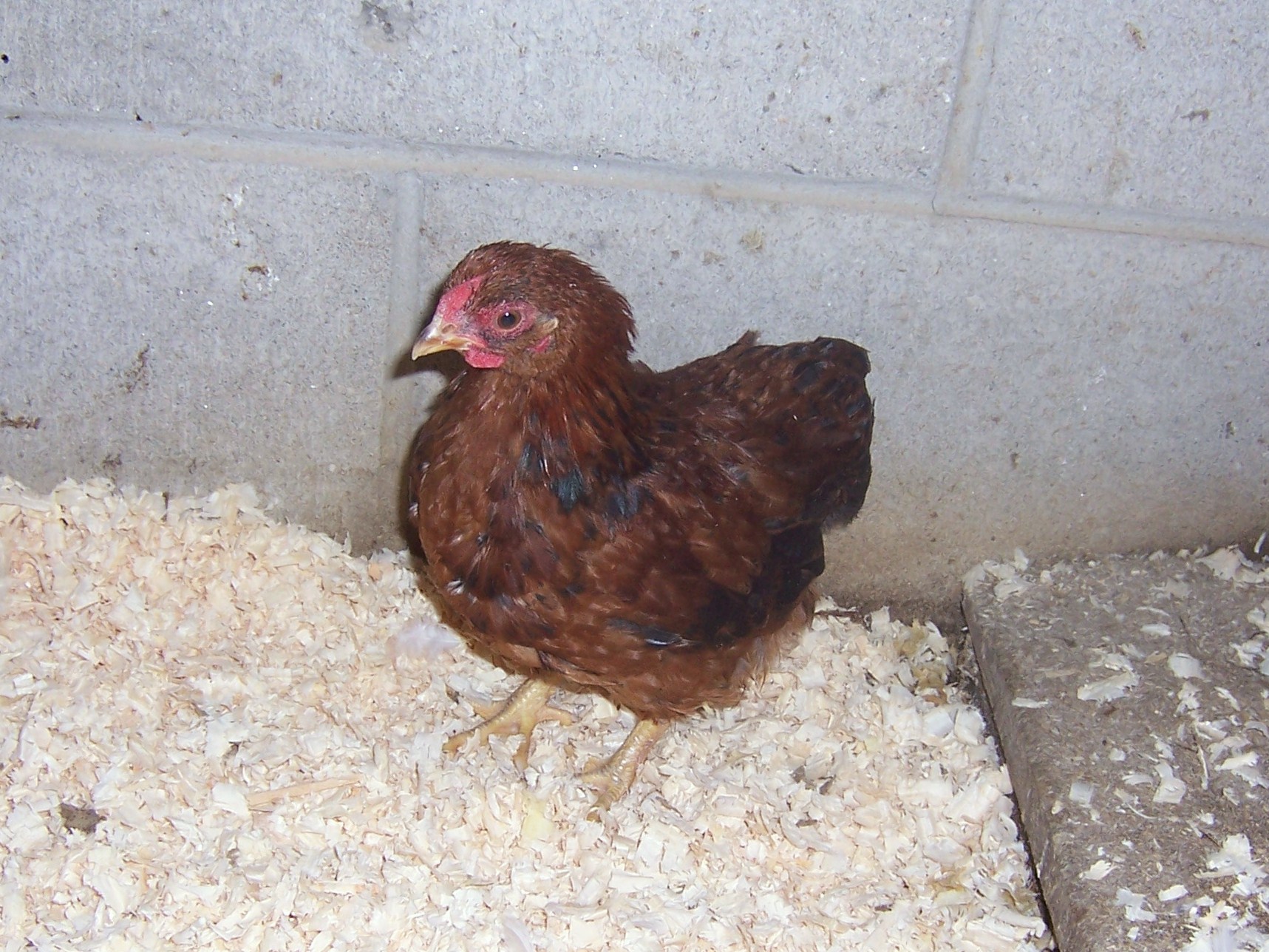
Gold Laced Wyandotte Bantam, 4 months old

So, there are still a few days left of spring, the time when a young man’s fancy lightly turns to… chicks! You know, the kind that come from hens (we’re talking flock expansion here).

We have been anxiously awaiting the call from Longhorn since last week’s false alarm, when the anticipated arrival date (June 11th) came and went with no new babies! The due date was revised; the new date set was June 16th.

The new date came, and this time the chicks have indeed arrived! We got the call at 9:04AM. My husband headed over with his wish list of preferred types of chicks to add to our flock.

Decisions have been made after much research online, in books, in conversation with other people (who either currently raise chickens or did at one time)…now he will try to match up our list with what they actually are offering. Room is always left to add an interesting surprise or two; following your gut instinct is important in chick-choosing.

Today the gut points to a Bantam chick that my husband describes as “interesting”. Bantams are roughly half (or less) the size of “regular” sized chickens, which can be a boon for you if you are raising chickens in a small space. Of course, their eggs are smaller (and cuter!) too, but hey, sometimes you only need a little egg for your cooking project (like when you are breading cutlets, or making an egg wash for a pie or stromboli). It can be a bigger risk  that you may end up with a boy instead of girl when you choose a bantam, but some of the Bantams are just so “interesting” that it’s a chance you willingly take. Well, we take the chance more often than not.

The new chicks are now happily ensconced in their own little coop, where they will stay until they are ready for assimilation into the main coop.

This slideshow requires JavaScript.

reasons to keep a (possible) rooster

the rescued runt!

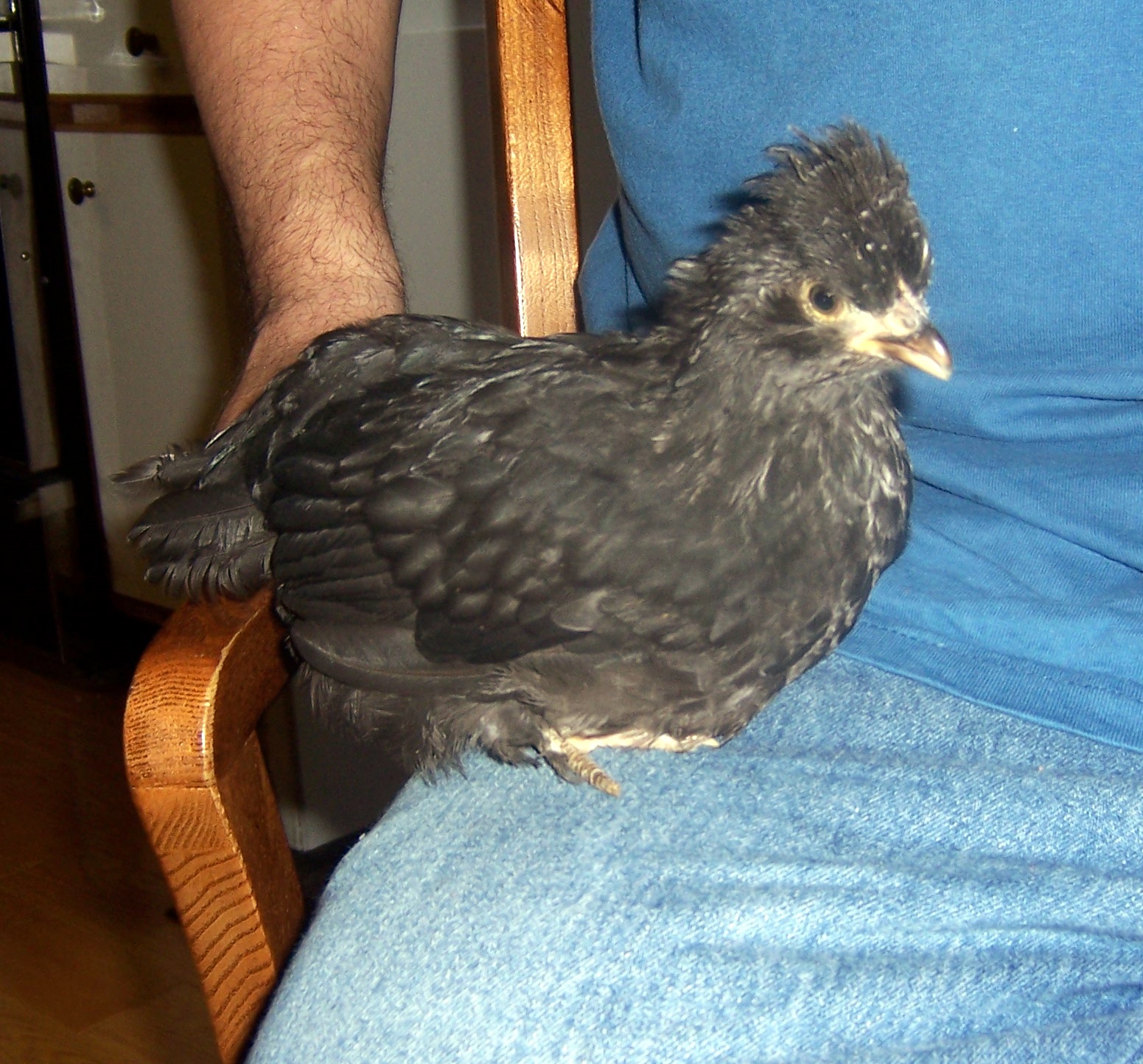
recently my husband was at the feed store getting (you guessed it!) feed and supplies for the chickens. in the chick brooder outside, there were baby chicks and while he was waiting, he stopped to take a peep (:)) at them. Longhorn is a good source for baby chickens if you are looking for just a few chicks (rather than the lot of 25 that many online hatcheries require you to order). now, my husband is sort of a chicken snob, ordering from texas, iowa, specialty breeders to get unique egg colors from our flock, since most of our hens are chosen for egg color, size, and quality. this day, one chick in particular caught his eye, and when he was finished with his feed transaction, he asked ‘what’s the odd-looking chick?” the clerk replied, “it’s an oddball mixed breed from an incubator project”. “i think it’s a rooster,” he added. now as i’ve mentioned in the past, you generally can’t give roosters away, and labeling it thus would typically have been the kiss of death, but it was this little guy’s lucky day, because when the clerk said, “you can have ‘im if you want ‘im,”  instead of averting his eyes and politely declining, my husband said, “okay!” and rescued him. he traveled to his new home in a spot-light bulb box. sigh. This chick has personality; it’s what made him stand out and, in the end, what saved him.

So, reasons to keep a possible rooster:

  1. it has a unique feature; this guy has a fluffy gray crest on his head and some perky tail feathers
  2. (s)he has a pretty trilling peep
  3. (s)he is petite; well, to call a spade a spade…is the runt of the litter, calling out to be saved.

Next issue: to name or not to name it? what would you do?